
Insights · Hotels and resorts
Why in-room dining earns less than it could
In upper-tier properties, guests don't give up on in-room dining because of the price. They give up because ordering costs them more than what they wanted is worth.
The bill nobody sees
In almost every property, in-room dining is judged on one number: how much it takes compared with the restaurant. It is a comparison in-room dining always loses, and one that says nothing useful, because it sets a service the guest has to go looking for against one they find with the table already laid.
The more useful question is a different one: how many times, during a stay, did a guest want something in the room and not ask for it. That number appears in no report. There is no line recording the coffee not ordered at four in the afternoon, the bottle of water taken from the minibar instead of requested from the bar, the dessert passed over because it was eleven at night and it felt like an imposition.
It is an invisible bill, and in a property with many rooms it is the largest of the three.
Three points of friction, all of them small
None of the reasons a guest doesn't order is dramatic. They are all small, and that is precisely why nobody tackles them.
The first is the telephone. Calling reception means deciding what you want before you know it, saying it aloud to someone and, in an international property, saying it in a language that isn't your own. A guest unsure about the menu doesn't call: they give up. A guest who doesn't speak good Italian does the same.
The second is the hour. In-room dining is wanted above all at the times when the property is at its quietest: mid-afternoon, after dinner, late evening. These are exactly the hours when guests worry about being a bother — and, in a luxury property, the feeling of being a bother is a detail they remember.
The third is the menu card. In most rooms the in-room dining menu is a folder on the desk or a page on the television. Neither is pleasant to browse, and neither shows the food. A guest who doesn't see a dish doesn't order it: not out of mistrust, but because it simply doesn't occur to them.
The moment you order isn't the moment you decide
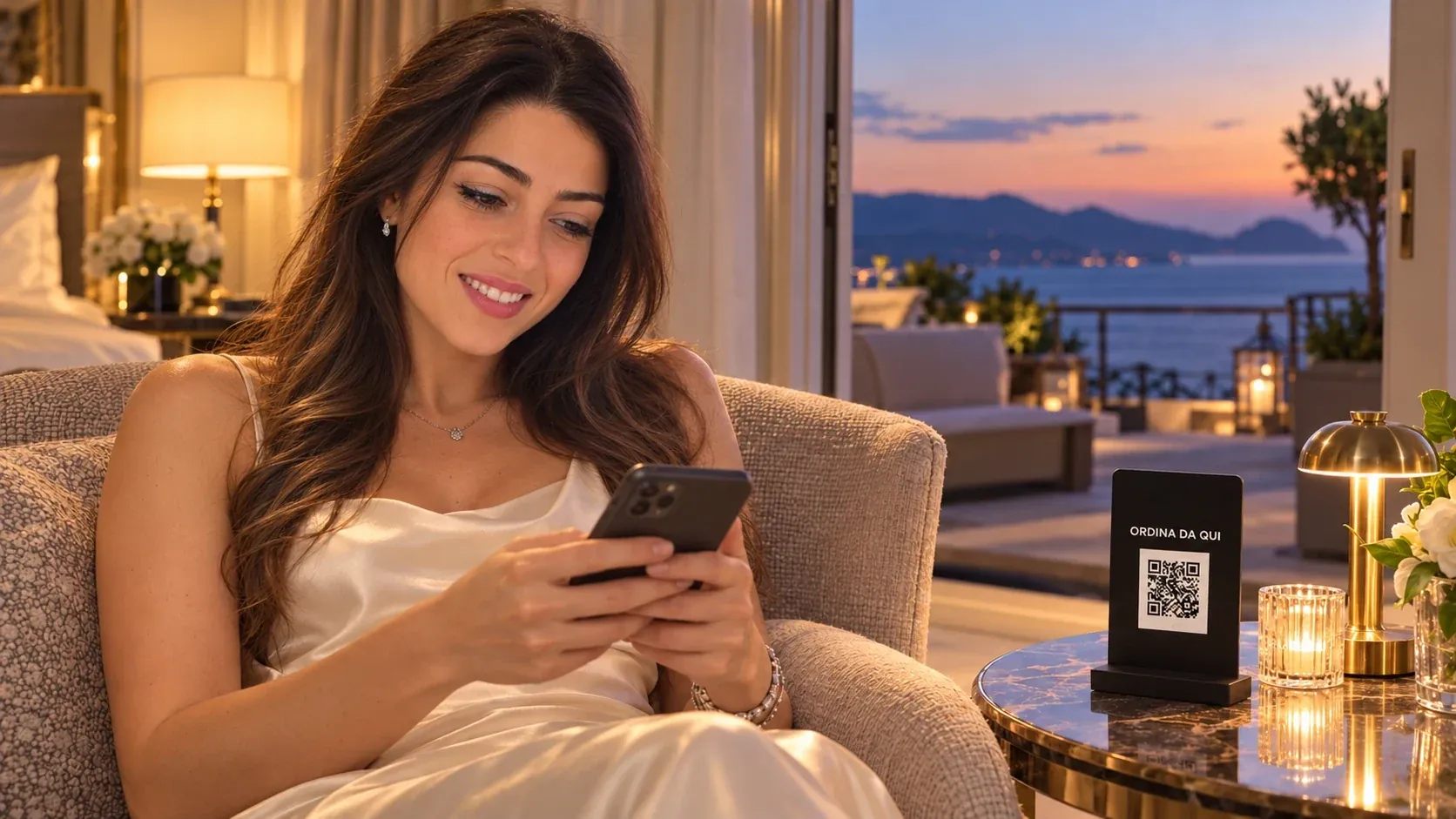
There is a detail anyone who runs F&B knows well and that traditional in-room dining ignores: wanting and deciding don't happen at the same time. A guest lying on the bed after a day in the sun thinks about a gin and tonic for three minutes. If, in those three minutes, ordering takes a single gesture, the order exists. If it means getting up, finding the number, calling and waiting, the craving passes within those three minutes.
This explains why properties that cut the number of steps see orders appear that weren't there before, rather than seeing their existing orders grow. It isn't an order moved from one channel to another: it is an order that simply wasn't being born.
Why an app isn't the answer
Many properties have tried to solve this with a dedicated app, and almost all of them have run into the same obstacle: guests don't install it. The international trade press has gone as far as calling the alternative a standard: “the standard in 2026 is a web-first flow opened from a QR code or a link, with no app install”, and the reason is stated plainly — someone staying one or two nights won't install software for a single stay (Hotel Tech Insight, Digital room service and mobile ordering, 2026).
It is an obvious observation, and a decisive one: every step added between wanting and ordering reduces the number of orders, and an installation is the most expensive step there is.
What is worth looking at
If a general manager wanted to measure their in-room dining without buying anything, three questions would be enough.
How many orders come from the rooms during the quiet hours — mid-afternoon and after ten at night. If there are few, it isn't because guests want nothing: it is because at those hours ordering costs more.
How many orders come from the common areas — rooftops, terraces, relaxation areas, the poolside. In many properties the answer is “none, we don't serve there”, and those are the longest hours a guest spends outside the room.
How many languages the in-room dining menu has. If it has one, some guests don't read it and don't order from it.
None of the three needs a new system to be observed. Taken together, all three tell you whether the problem is the menu, the price or the distance.